
Wiki.js
Open SourceNext-generation open-source wiki – self-hosted & scalable
AI Summary
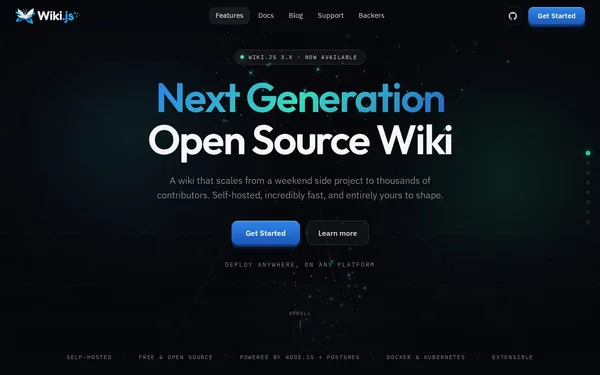
Wiki.js is a powerful, self-hosted open-source wiki platform built on Node.js and PostgreSQL. It offers real-time collaboration, multiple editors (Markdown, Visual, AsciiDoc), Git synchronization, and granular permission management. The tool is aimed at development teams, organizations, and communities that need a scalable and fully controllable knowledge base.
✓ Pros
- +Fully self-hosted and open source – no dependency on external services
- +Extensive editor selection (Markdown, Visual, AsciiDoc, Excalidraw) plus real-time collaboration
- +Granular permission management with OIDC, LDAP, SAML, and path-based access control
✗ Cons
- −Self-hosting requires technical expertise for setup, maintenance, and updates
- −No hosted SaaS plan available – full infrastructure responsibility lies with the operator
Use Cases
- →Building internal company documentation with group- and path-based access control
- →Collaboratively writing and editing incident reports or technical specs in real time
- →Managing multilingual documentation with locale-based routing and Git synchronization
- →Running multiple independent wiki instances (multi-site) on a single deployment base
Who is it for?
Ideal for development teams, DevOps engineers, and technically proficient organizations looking to run a scalable, fully self-controlled knowledge base.
Tags
What is Wiki.js?
Wiki.js is a self-hosted wiki platform built on Node.js and PostgreSQL. It is designed for teams and organizations that want to maintain full control over their documentation infrastructure. The source code is open, and there is no hosted SaaS plan available. Anyone using Wiki.js runs the infrastructure themselves.
Core Features
- Multiple editors: Markdown, visual editor, AsciiDoc, and Excalidraw are all available on equal footing. Teams can choose the appropriate mode per page or user group.
- Real-time collaboration: Multiple people can work on pages simultaneously – for example, when co-authoring incident reports or technical specifications.
- Git synchronization: Content can be synchronized bidirectionally with a Git repository, enabling versioning and workflow integration outside the wiki interface.
- Granular permission management: Access rules can be defined at the path level. For authentication, Wiki.js supports OIDC, LDAP, and SAML.
- Multilingual support and multi-site: Documentation in multiple languages with locale-based routing, as well as multiple independent wiki instances on a shared deployment base, are both supported.
Who is Wiki.js for?
Wiki.js is suited for development teams and DevOps engineers who want to run a knowledge base without storing content with a third-party provider. Typical use cases include internal company documentation with group-based access control or technical documentation with Git integration.
The platform requires a basic level of technical knowledge. Without experience with Docker or Linux server environments, the initial setup can become a significant hurdle. Updates and maintenance remain permanently the responsibility of the operator. For small teams without their own infrastructure, this represents a real overhead that needs to be factored in.
Classification & Alternatives
Wiki.js belongs to the category of self-hosted knowledge bases, alongside tools such as Outline, BookStack, or the classic MediaWiki. What sets it apart from these alternatives is primarily its combination of a modern interface, Git synchronization, and a broad range of authentication options.
Anyone already running a Confluence instance and simply looking to cut costs will not automatically find less complexity in Wiki.js. On the other hand, those who need full data control, want to integrate Git workflows into their documentation, and have the necessary infrastructure in place will find a platform that forces few compromises.