
DesignCraft
Open SourcePage layout & publishing rebuilt in pure Rust
AI Summary
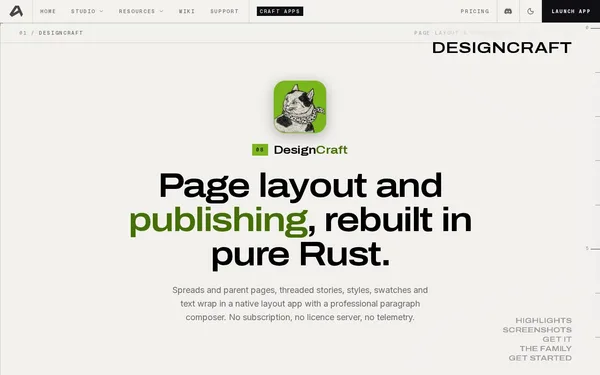
DesignCraft is an open-source desktop application for professional page layout and publishing, built entirely in Rust. It offers spreads, linked text frames, paragraph and character styles, print-ready PDFs with CMYK support, and a Knuth-Plass paragraph composer. The tool is aimed at designers, publishers, and developers looking for a powerful, subscription-free alternative to traditional layout applications.
✓ Pros
- +Completely free and open source – no subscription, no license server, no telemetry
- +Agent-native: full control via JSON and MCP server for automation
- +Broad platform support: macOS, Windows, Linux (incl. ARM, RISC-V), FreeBSD, and web
✗ Cons
- −Still in active development – no stable release yet, feature set not yet complete
- −Relatively new software with no established community or extensive documentation
Use Cases
- →Creating print-ready layouts with bleed, crop marks, and PDF/A output
- →Designing multi-page publications with master pages and linked text columns
- →Automated publishing via JSON control channel or MCP server
- →High-quality typesetting with hyphenation and optical margin alignment
Who is it for?
Ideal for designers, publishers, and technically minded creatives looking for a professional, subscription-free, open-source layout tool.
Tags
What is DesignCraft?
DesignCraft is an open-source desktop application for professional page layout and publishing, written entirely in Rust. The project picks up where proprietary subscription solutions from established vendors have lost many users: it requires neither a license server nor monthly fees. Rather than relying on Electron or similar runtimes, DesignCraft is built on Rust, which has a direct impact on startup performance and memory usage. The application runs natively on macOS, Windows, Linux (including ARM and RISC-V architectures), FreeBSD, and in the browser.
Core Features
- Spreads and linked text frames for multi-page publications with master pages and flowing text columns
- Knuth-Plass paragraph composer with hyphenation and optical margin alignment for typographically clean text
- Print-ready PDF output with CMYK support, bleed, crop marks, and PDF/A compatibility
- Paragraph and character styles for consistent formatting across multi-page documents
- JSON control channel and MCP server for fully automated publishing workflows without manual intervention
Who is DesignCraft for?
DesignCraft is primarily aimed at designers and publishers who want to avoid subscriptions while still producing print-ready results. It is especially relevant for developers and technically minded creatives who want to automate layout processes. The MCP server allows the application to be controlled entirely via script – for example, to generate catalogs or reports from data sources without ever opening the UI. Since no stable release exists yet and the documentation is still being built out, DesignCraft is currently best suited in production environments for users who are comfortable working with software in active development and are willing to report issues as they arise.
Context & Alternatives
DesignCraft is a direct competitor to established page layout applications such as Adobe InDesign and Affinity Publisher. In the open-source space, Scribus has been a mature tool for years, backed by a broad community and extensive documentation. Scribus offers stability and a proven feature set, but lacks a native automation interface comparable to DesignCraft's JSON and MCP channels. For anyone looking to control layouts programmatically or integrate them into AI-driven workflows, DesignCraft offers an approach that Scribus does not. That is the concrete differentiator that can justify the development risks.