
blaze
Open SourceRust builds up to 92x faster than cargo/rustc
AI Summary
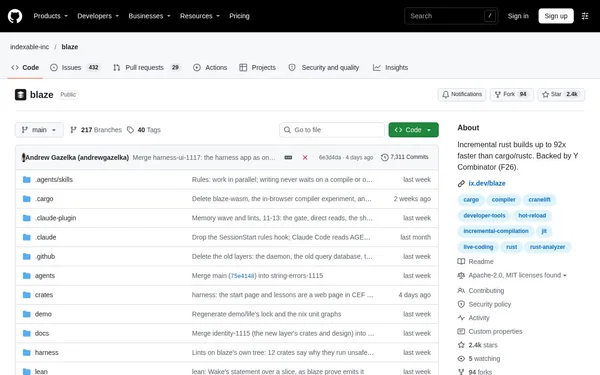
blaze is a drop-in replacement for cargo that dramatically speeds up Rust projects through incremental in-memory compilation. Instead of restarting cargo and rustc, a background daemon keeps the project compiled and only rebuilds changed functions. The tool is aimed at Rust developers who need faster build times and shorter development cycles.
✓ Pros
- +Up to 92x faster incremental builds compared to cargo/rustc
- +Seamless integration – simply type blaze instead of cargo
- +Supports real-world large projects (Servo, Zed, bun) and is YC-backed
✗ Cons
- −Requires several GB of RAM, as the project is kept in memory
- −Windows support not yet complete; live edits are still missing in v2
Use Cases
- →Faster iterative development of Rust projects with rebuilds in milliseconds
- →Live coding with automatic hot-reload on file changes
- →Accelerating large Rust codebases such as Zed, Servo, or bun
- →Replacing cargo build/test/run in the local development workflow
Who is it for?
Rust developers on macOS (Apple Silicon) and Linux who want faster build cycles in their day-to-day local development.
Tags
What is blaze?
blaze is a drop-in replacement for cargo, the standard build tool of the Rust community. Instead of restarting cargo and rustc on every build, a background daemon keeps the project compiled in memory and only rebuilds the functions that have changed since the last invocation. The result: incremental builds that, according to the project, complete up to 92x faster than with cargo or rustc alone.
Core Features
- Incremental in-memory compilation: The daemon retains the compiled state of the project in RAM. Changed functions are rebuilt in isolation, while unchanged parts remain untouched.
- Transparent cargo replacement: blaze can be called directly in place of
cargo build,cargo run, orcargo test. Existing workflows require no restructuring. - Hot-reload on file changes: In live coding mode, blaze automatically detects file changes and triggers a rebuild without any manual intervention.
- Support for real-world large projects: The tool has been tested on codebases such as Servo, Zed, and bun, and is backed by Y Combinator.
Who is blaze for?
blaze targets Rust developers on macOS (Apple Silicon) and Linux who frequently rebuild as part of their daily workflow: during iterative feature development, while writing tests, or when experimenting with larger codebases. The benefit is most noticeable where cargo builds previously took several seconds or minutes.
Two limitations are worth knowing. blaze keeps the entire project in memory, which can consume several gigabytes of RAM. Windows is not yet fully supported. Those waiting for live edits as envisioned in v2 will need to be patient.
Context & Alternatives
blaze belongs to the category of build accelerators for Rust, alongside tools such as cargo-watch (automatic rebuild on file changes) or sccache (distributed build caching). The key difference: while these tools operate at the level of processes or caches, blaze keeps the compiler state persistent in memory, completely avoiding the costly restart of rustc. Developers working primarily on Apple Silicon or Linux who experience long rebuild times as a bottleneck will find blaze to be the most direct solution.